

Here's something that honestly blew my mind when I first saw the research - a recent German university study tracking 58 kids with ADHD found that just four months of skateboarding activities improved their cognitive test performances by 17-26% and reduced attention deficit symptoms by 19.5%. What makes it even more interesting is that these weren't professional skaters or athletes. Just regular school-aged children between 8-13 years old discovering movement through an activity they actually enjoyed.
Living in Berlin for the past four years and working in graphic design, I've watched how skateboard culture evolved from pure street rebellion into something entirely different. When I was organizing art events back in my Red Bull Ukraine days, parents would ask me constantly: "Is this appropriate for my kid?" They'd point at skateboard graphics thinking they were too edgy, too street, too... well, honestly, they just didn't understand the art history behind most quality deck designs.
But here's the thing - introducing children to skateboard wall art isn't about exposing them to aggressive street culture at all. It's actually one of the most sophisticated ways to teach art history while creating an environment that genuinely stimulates cognitive development. The Metropolitan Museum of Art's Renaissance education resources state that studying gesture, narrative, and perspective in classical paintings helps students work exactly as Renaissance artists did. Now imagine putting those same masterpieces on skateboards in your kid's room.
That's where age-appropriate skateboard art collections become... actually, let me tell you about this project I worked on last year.
Why Traditional Museums Fail Kids (But Skateboard Art Doesn't)
I mean, think about it - when was the last time your 8-year-old got excited about visiting a museum? Exactly. Research from East End Arts shows that art benefits in early childhood are deeply intertwined with cognitive, physical, and socio-emotional growth. But museums have this weird problem: they're designed for adults who can stand still for 45 minutes analyzing single paintings.
Kids need art they can actually interact with on their terms.
When I first moved here from Ukraine in 2021 (actually it might have been late 2020... pandemic time was weird), I noticed something really specific about how Berlin families approached interior design for children's spaces. Unlike the bright primary-color explosion you see in American kids' rooms, there was this interesting balance between sophisticated artistic elements and age-appropriate accessibility. Skateboard wall art hit that sweet spot perfectly.
From my experience in branding and working with Ukrainian streetwear brands, I've learned that the the composition and color psychology of art affects how children process visual information. Early exposure to artistic activities - according to BBM Academy research - significantly impacts brain development, laying the foundation for future learning success. But you can't just throw any art on walls and expect cognitive benefits.
Age matters. A lot.
The Developmental Stages Nobody Talks About
Here's what most people don't realize about introducing classical art to children through skateboard decks:
Ages 5-7: The Pattern Recognition Phase At this age, kids are developing what cognitive scientists call "patterning skills and cause-effect understanding." They're not ready for complex Renaissance narratives yet, but they absolutely respond to bold shapes, primary color schemes, and recognizable figures. That's exactly what makes simplified Renaissance compositions on skateboards work so well.
Back in my Red Bull Ukraine days organizing creative workshops, I watched 6-year-olds gravitate toward skateboard decks featuring Da Vinci's geometric studies way before they understood perspective. The visual patterns alone activated their developing spatial reasoning.
Ages 8-10: The Narrative Discovery Phase This is when children start understanding stories within art. They can look at a Renaissance painting and ask "why is that person pointing?" or "what's happening here?" Their working memory develops significantly during these years - which the German ADHD study confirmed improved by 20% through skateboard-related activities.
Ages 11-13: The Technical Appreciation Phase Pre-teens begin noticing technique, style differences, and artistic choices. They can understand concepts like sfumato, chiaroscuro, and compositional balance. This is the perfect age for introducing museum-quality Renaissance skateboard reproductions that showcase technical mastery.
My background in vector graphics helps me see how these developmental stages align perfectly with different complexity levels in skateboard art collections.
Curating Your First Age-Appropriate Collection
When I was designing our skateboard wall art collections at DeckArts, honestly the biggest challenge wasn't finding great Renaissance artworks to reproduce. It was figuring out which specific pieces would work for specific age groups without overwhelming kids or... how do I explain this... without dumbing down the art so much it lost its educational value.
Starting Simple: The 5-7 Year Old Foundation
For younger children, you want skateboard art that features:
- Strong geometric compositions (Leonardo's Vitruvian Man works surprisingly well)
- Clear, recognizable subjects (like our Bouguereau's Birth of Venus deck with simplified classical beauty)
- Bold color contrast (the Frida Kahlo Self-Portrait deck works brilliantly with its vibrant palette)
- Limited visual complexity (single-figure compositions over crowded scenes)
Having worked with streetwear brands taught me something crucial about design for younger audiences: negative space matters more than complexity. Kids process visual information differently than adults, and cluttered Renaissance battle scenes - however historically significant - will just stress them out rather than inspire curiosity.
Building Complexity: The 8-10 Year Old Collection
This is where it gets really exciting, honestly. Middle childhood is when you can introduce:
- Narrative compositions (scenes that tell obvious stories)
- Multiple figures interacting (but not crowded compositions)
- More sophisticated color palettes (earth tones, subtle gradations)
- Recognizable art historical moments (like our Caravaggio Medusa deck with its dramatic emotion)
I remember working on a project with a Kyiv-based children's museum (before the war, obviously), and we tested different Renaissance compositions with kids aged 8-10. The pieces that generated the most engagement weren't the most famous paintings - they were the ones with clear emotional expressions and dynamic poses. Kids wanted to understand what people in the paintings were feeling.
That same psychology applies to selecting skateboard wall art for this age group. You're not just decorating - you're creating conversation starters about human emotion, historical context, and artistic technique. That's exactly what we captured in our luxury skateboard art collections.
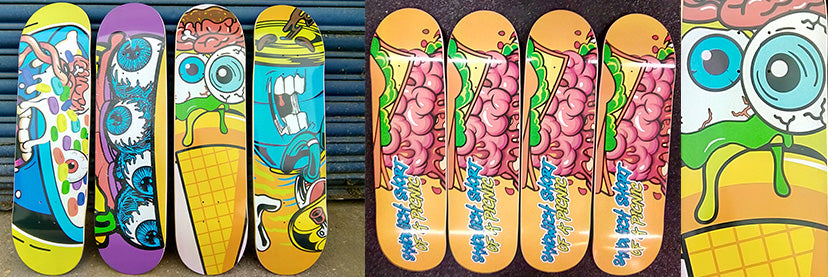 Alt: Skateboard wall art featuring fusion of artistic styles with vibrant color skateboarding design for contemporary home display
Advanced Collections: The 11-13 Pre-Teen Gallery
Here's where you can really push boundaries (in a good way). Pre-teens are ready for:
- Technical masterpieces (complex perspective studies, intricate details)
- Full Renaissance scenes (complete compositions like our Gustav Klimt The Kiss or John Everett Millais Ophelia)
- Art historical context (understanding why certain pieces matter)
- Personal collection curation (letting them choose based on their own aesthetic preferences)
From a design perspective, what makes this work on skateboard decks specifically - as opposed to traditional posters - is the format itself. The elongated vertical shape of a deck naturally focuses attention on compositional elements that might get lost in a standard rectangular print. It forces both the curator (you) and the viewer (your kid) to think about how Renaissance artists used space within constraints.
You can see this perfectly in our diptych collections like Bouguereau Amor & Psyche where two boards create a panoramic masterpiece that tells a complete visual story.
The Practical Setup: Installation and Presentation
 Alt: Modern style skateboard art set of four premium maple decks displaying coordinated artistic designs horizontal gallery arrangement
Honestly, this is where most parents mess up, and I've done it myself when I was... actually, let me tell you about the first time I tried hanging skateboard art in my Berlin apartment.
I thought I could just nail three decks to the wall randomly and call it "gallery style." It looked terrible. Like a teenager's bedroom, not curated children's art space. The issue wasn't the skateboards or the art - it was understanding that presentation affects how children perceive and value what they're looking at.
Height and Accessibility
For 5-7 year olds:
- Mount decks at 36-42 inches from floor (their eye level)
- Use horizontal orientation for easier viewing
- Space multiple pieces 6-8 inches apart
- Keep arrangements simple (1-3 pieces maximum initially)
For 8-10 year olds:
- Increase height to 42-48 inches
- Can introduce vertical mounting
- Create small "collections" of 3-5 related pieces
- Allow them to rearrange periodically
For 11-13 pre-teens:
- Standard gallery height (54-60 inches)
- Mix horizontal and vertical orientations
- Encourage them to curate their own arrangements
- Rotate pieces seasonally based on their interests
My background in graphic design and branding work with Ukrainian streetwear brands showed me that presentation context completely changes how we process visual information. The same Renaissance skateboard deck mounted at adult height reads as "decoration" - mounted at child height becomes "my art."
Lighting Considerations
Natural light works best for any art, but be careful with direct sunlight (it will fade prints over time). When organizing art events for Red Bull Ukraine, we learned that angled lighting creates dramatic shadows that help children understand three-dimensional form in two-dimensional art.
For skateboard wall art specifically:
- Use adjustable picture lights if possible
- Avoid fluorescent overhead lighting (creates weird color casts)
- Consider LED strip lighting behind decks for evening ambiance
- Natural window light from the side emphasizes texture
The same principles we discuss in our home office skateboard art guide apply to children's spaces too.
 Alt: Skateboard canvas wall art featuring Hokusai Great Wave design in horizontal format for skateboard enthusiasts home decor
Common Questions Parents Actually Ask Me
Frequently Asked Questions
Q: Why choose Renaissance skateboard wall art over traditional posters or prints for children's rooms? A: From my decade of experience in graphic design and art curation, skateboard decks offer something posters can't - dimensional depth and cultural relevance that resonates with modern kids. The format bridges classical art appreciation with contemporary street culture, making Renaissance masterpieces feel accessible rather than stuffy or outdated. Research shows early artistic exposure significantly impacts cognitive development, and skateboard art removes the "museum intimidation factor" while maintaining educational value. Plus, the tactile element of real Canadian maple decks creates stronger memory associations than flat paper prints.
Q: How much does museum-quality Renaissance skateboard art cost for children's collections? A: Age-appropriate skateboard art collections typically range from $80-250 per deck depending on print quality, wood grade, and artistic complexity. Single pieces like our Bouguereau Birth of Venus or Frida Kahlo deck work for starter collections, while pre-teen collections feature full Renaissance scenes like Klimt's The Kiss on premium maple at higher investment levels. The key is starting with 2-3 pieces and building gradually as your child's appreciation develops - not overwhelming their space or your budget initially.
Q: What makes classical art skateboard decks suitable for different age groups? A: Working directly with Ukrainian streetwear brands and organizing Red Bull Ukraine art events taught me that developmental psychology drives everything in age-appropriate art selection. Younger children (5-7) need bold geometric patterns and high color contrast for pattern recognition development. Middle childhood (8-10) responds to narrative scenes and emotional expressions that build working memory - perfect for pieces like our Caravaggio Medusa. Pre-teens (11-13) appreciate technical mastery and can understand historical context in works like our Millais Ophelia. Quality skateboard art adapts Renaissance compositions to these developmental stages.
Q: Can Renaissance skateboard art be displayed in professional or educational settings beyond children's bedrooms? A: Absolutely - my experience in branding for professional spaces shows skateboard art works brilliantly in pediatric offices, children's libraries, progressive schools, and family-focused businesses. The format communicates cultural sophistication while remaining approachable and non-threatening to young visitors. Educational institutions particularly benefit because skateboard wall art creates natural conversation starters about art history, technique, and cultural evolution. I've consulted on installations for Kyiv children's museums and Berlin family spaces where Renaissance skateboard collections serve dual purposes - aesthetic enhancement and educational resource.
Q: How durable are fine art skateboard prints for long-term wall display in children's spaces? A: Museum-quality skateboard art uses UV-resistant inks on professional-grade Canadian maple decks that last 15-20 years with proper care (indirect light, stable humidity). From a technical design perspective, quality decks handle children's environments better than paper prints - they don't tear, crease, or suffer water damage from spills. The wood substrate actually improves visually with age, developing patina that adds character. For younger children's rooms where accidents happen frequently, skateboard decks provide worry-free durability that traditional framed prints can't match. Just avoid direct sunlight exposure and they'll outlast your kid's current aesthetic preferences.
Q: Should I let my child actually skateboard on Renaissance art decks, or are they purely decorative? A: Here's what most people don't realize - quality museum reproduction decks aren't meant for riding. The printing process and protective coatings prioritize visual fidelity over grip tape functionality. These are art pieces using skateboard format, not functional sports equipment. However, this creates an important teaching opportunity: explaining to children that art can exist in unexpected formats, and that the same object can serve different purposes based on context. I've found kids aged 8+ understand this distinction easily and actually appreciate that "their" Renaissance art occupies the same cultural space as the skateboards they see in street culture.
Q: How do I know when my child is ready to move from simple compositions to more complex Renaissance scenes? A: From organizing 15+ art events and watching hundreds of children interact with visual art, the signals are pretty clear. When your kid starts asking questions about what's happening in the artwork (not just identifying colors or shapes), they're ready for narrative complexity like our diptych collections. When they notice technique differences or ask why one painting "looks different" from another, that's your cue to introduce technical masterpieces. The German skateboarding study I mentioned earlier showed that attention-focusing abilities improve significantly with exposure to complex visual patterns - so your child's growing curiosity is actually evidence of cognitive development in action.
About the Author
Stanislav Arnautov is the founder of DeckArts and a creative director originally from Ukraine, now based in Berlin. With over a decade of experience in branding, merchandise design, and vector graphics, Stanislav has collaborated with Ukrainian streetwear brands and organized art events for Red Bull Ukraine. His unique expertise combines classical art knowledge with modern design sensibilities, creating museum-quality skateboard art that bridges Renaissance masterpieces with contemporary street culture. His work has been featured in Berlin's creative community and Ukrainian design publications. Follow him on Instagram, visit his personal website stasarnautov.com, or check out DeckArts on Instagram and explore the curated collection at DeckArts.com.


0 comments